The Australian higher education sector is currently weathering a “perfect storm” of technological disruption. From the sandstone corridors of the University of Sydney to the digital hubs of RMIT, the integration of Artificial Intelligence (AI) has shifted from a futuristic concept to an everyday reality. As we move through 2026, the focus has pivoted: it is no longer just about whether students use AI, but how universities can redesign assessments to ensure they remain a true measure of human capability.
For the modern Aussie student, this transition brings both unprecedented opportunity and significant pressure. While generative AI can assist in brainstorming, the rigorous standards set by the Australian Qualifications Framework (AQF) remain unchanged. Navigating this new landscape requires a sophisticated balance of tech-fluency and traditional academic rigor.
The Institutional Response: Policy in Practice
Australian universities are not reacting with a monolithic strategy; instead, each institution is carving out a specific framework to balance innovation with integrity.
For instance, Deakin University’s approach to AI has been pioneering, focusing on “CRADLE” (Centre for Research in Assessment and Digital Learning). They emphasize that AI should be viewed as a co-collaborator in the creative process rather than a threat. Conversely, Western Sydney University’s integrity framework has leaned heavily into “Assessment 2.0,” which prioritizes the process over the product. This means students are often graded on the multiple drafts, prompts used, and research logs they produce, rather than just the final submission.
In this high-pressure environment where every university has its own rulebook, seeking expert mentorship is a strategic move. Many students look for reliable professionals to do my assignment for me by MyAssignmentHelp to ensure their work aligns with these varying academic integrity policies while mastering the complex digital tools now required for submission.
Data-Driven Insights: The 2026 Landscape
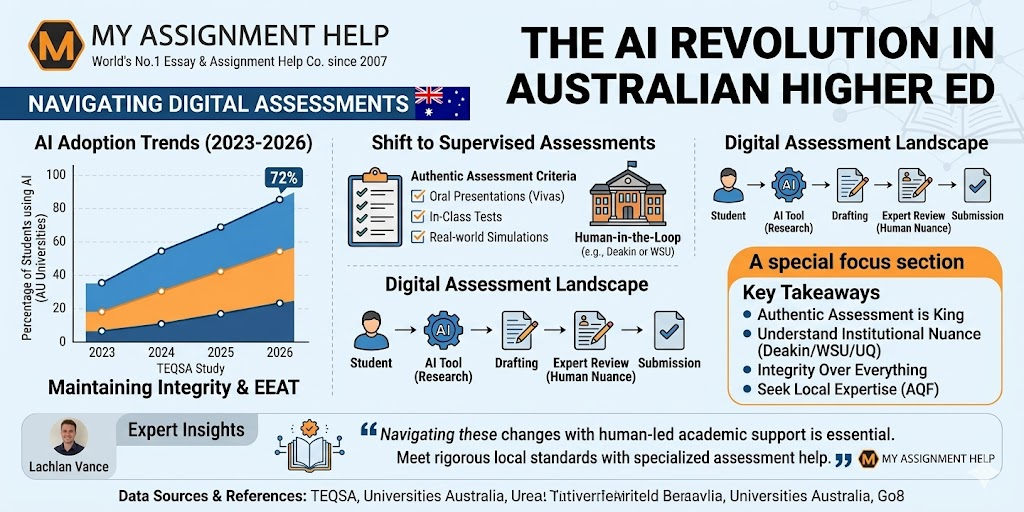
The Tertiary Education Quality and Standards Agency (TEQSA) has recently updated its guidelines to reflect a “human-in-the-loop” requirement for all high-stakes submissions.
| Metric | Percentage | Source |
| Students using AI for research/drafting | 72% | TEQSA 2025 Study |
| Universities implementing AI-viva exams | 45% | Group of Eight (Go8) Policy Update |
| Students concerned about AI-driven plagiarism | 58% | Universities Australia Student Survey |
Maintaining E-E-A-T in a Digital World
Experience, Expertise, Authoritativeness, and Trustworthiness (E-E-A-T) are the pillars of the Australian education system. As assessments become more technical, the need for verified, human-led support is paramount. Whether you are tackling a complex nursing care plan or a civil engineering simulation, the nuance provided by a subject matter expert cannot be replicated by an algorithm.
To bridge this gap, specialised assessment help has become a vital resource. Professional guidance ensures that students don’t just “finish” an assignment but actually understand the underlying methodology, meeting the specific grading rubrics of local institutions like Monash, UNSW, or the University of Queensland (UQ), which recently introduced a mandatory digital ethics module for all undergraduates.
Navigating the “Authentic Assessment” Shift
In response to the rise of Large Language Models (LLMs), many Australian institutions are moving away from traditional take-home essays in favour of “authentic assessments.” These are tasks designed to mimic real-world professional challenges, such as:
- Live Oral Presentations (Vivas): Defending your thesis in person.
- Supervised Simulations: Practical exams in controlled environments.
- In-Class Reflective Writing: Writing tasks completed under observation to verify the student’s “authorial voice.”
Key Takeaways
- Authentic Assessment is King: Expect more vivas, presentations, and in-person practicals.
- Institutional Nuance: Understand the difference between Deakin’s collaborative approach and WSU’s process-heavy framework.
- Integrity Over Everything: Use AI as a tool for research, not as a replacement for critical thinking.
- Seek Local Expertise: Australian academic standards are unique; ensure any help you receive understands the AQF.
Frequently Asked Questions (FAQ)
Q1: Are Australian universities banning AI?
No. Most institutions are “embracing the inevitable” by integrating AI literacy into the curriculum while tightening supervised assessment protocols.
Q2: How can I ensure my assignment meets Australian standards?
Focus on peer-reviewed Australian journals and ensure your referencing (APA7, MLA, or AGLC4) is precise. If you’re struggling, professional services can provide a template that aligns with these specific requirements.
Q3: What is a “Viva Voce” assessment?
It is an oral exam where you must explain your written work to a tutor. It is increasingly used in Australia to verify that the student actually produced the work themselves.
Q4: Does University of Queensland allow ChatGPT?
UQ allows AI use only when explicitly stated in the course profile. Students must often complete a digital ethics module before using it for assignments.
About the Author
Lachlan Vance
Senior Academic Consultant & Content Strategist at MyAssignmentHelp
With over 12 years of experience in the Australian higher education sector, Lachlan specialises in curriculum alignment and E-E-A-T compliant academic content. Having previously worked as a departmental researcher, he now focuses on helping students navigate the intersection of technology and academic integrity across major AU institutions. Lachlan is a frequent contributor to EdTech forums and is dedicated to maintaining the highest standards of student support.
References
- Tertiary Education Quality and Standards Agency (TEQSA). (2025). Assessment Reform for the Age of Artificial Intelligence.
- Universities Australia. (2026). Digital Transformation in Higher Education: Annual Report.
- Group of Eight Australia. (2025). The Future of the Australian PhD and Masters Assessment.